Can You Clean Fuel Injectors in an Ultrasonic Cleaner?
Yes—but with important caveats. Not all fuel injectors are the same, and not every ultrasonic cleaner is the same or appropriate for fuel injector service.
The effectiveness of ultrasonic fuel injector cleaning depends not only on the process itself, but on using the proper equipment to execute it correctly. We’ll elaborate below.
Types of Injectors That Can Be Ultrasonically Cleaned
Port Fuel Injectors (PFI)
The most common and the most forgiving—well suited to ultrasonic cleaning.
Gasoline Direct Injection (GDI)
Cleanable, but with caution. High internal pressures and tight tolerances demand careful frequency selection and controlled exposure.
Diesel Injectors
Mechanical diesel injectors respond well to ultrasonic cleaning. Solenoid- and piezo-controlled injectors require additional care due to sensitive internal components.
Critical Note:
Ultrasonic cleaning is only effective with injectors removed from the engine. On-car ultrasonic cleaning is impractical and ineffective.
Choosing the Right Ultrasonic Frequency
Ultrasonic cleaners are available in a wide range of frequencies, and frequency selection matters.
Low Frequencies (25–40 kHz)
Lower frequencies generate larger cavitation bubbles that collapse with more force. This makes them highly effective at removing heavy carbon, varnish, and stubborn contamination from injector bodies and clogged internal passages.
However, this aggressive action can be a liability for precision injectors—particularly GDI designs—where excessive exposure may cause micro-pitting or accelerated wear.
Higher Frequencies (60–130 kHz)
Higher frequencies produce smaller, gentler cavitation bubbles. These clean more uniformly and penetrate fine passages without the same risk of surface damage.
High-frequency ultrasonic cleaning is preferred when:
-
Injectors have thin-wall or precision-machined components
-
Delicate valve seats or seals are present
-
Multi-hole injector nozzles require precision rather than brute force
Frequencies above 120 kHz are generally reserved for microfluidic or laboratory components and are rarely necessary for fuel injectors.
Advanced Ultrasonic Features That Matter
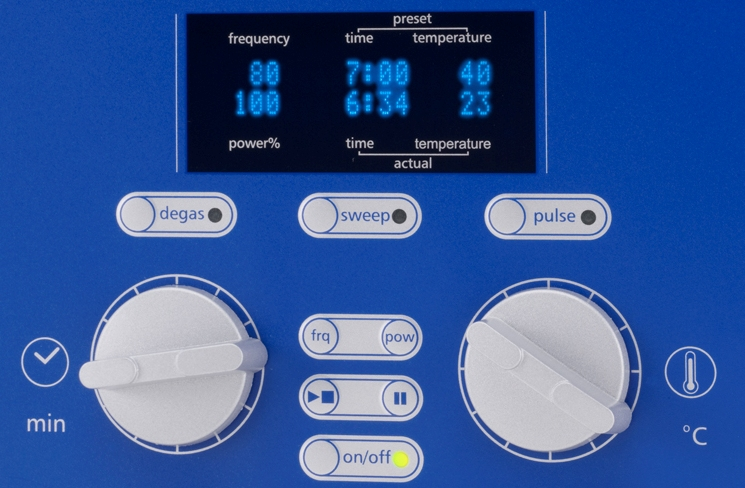
Sweep Mode
Continuously varies frequency to prevent standing waves, improving uniformity and reducing the risk of hot spots or uneven cleaning. Optimal uniform cleaning, especially for complex, multi-hole injectors.
Degas Function
Removes dissolved air from the cleaning solution, allowing cavitation to form more efficiently.
Pulse Mode
Delivers short bursts of increased ultrasonic intensity to help break loose stubborn deposits.
When available, these features significantly improve cleaning effectiveness and are especially valuable in professional injector service environments.
Laboratory- and Shop-Grade Ultrasonic Equipment
Ultrasonic cleaning isn’t just about theory—the results ultimately depend on the quality of the equipment. Proper power control, stable frequency output, and purpose-built fixtures make the difference between basic cleaning and truly effective injector restoration.
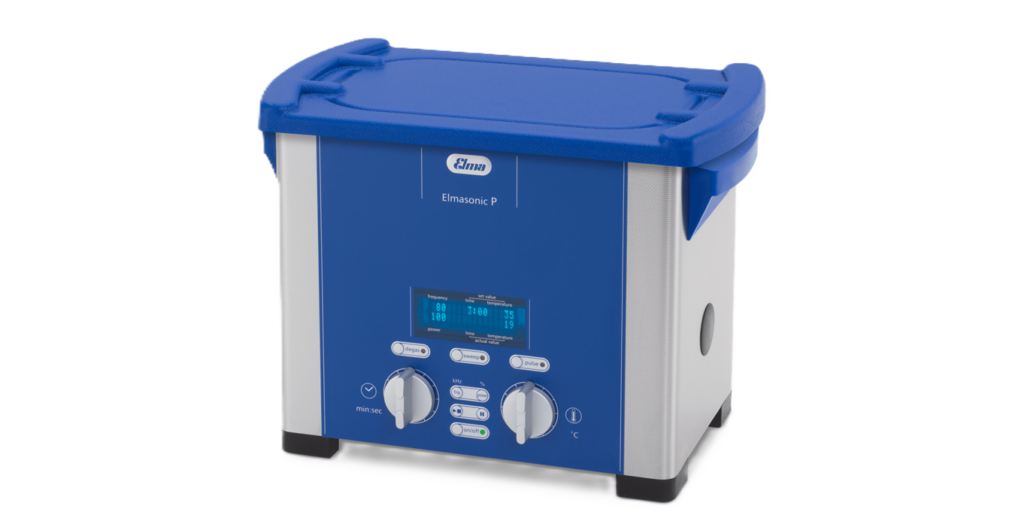
For our Ultrasonic cleaning of fuel injectors we primarily use the Elmasonic P60H and sometimes the Elmasonic EP60H depending on the scenario.
While most shops rely on Chinese ultrasonic units or smaller premium systems like Crest—typically limited to around 180 W of total ultrasonic output and fixed 37 kHz frequency. Our Elma P60H is equipped with the most powerful commercially available transducers, delivering an impressive 780 W of ultrasonic cleaning power with variable power and selectable kHz frequencies, power % and multiple modes. Some injectors require less power some require more power. The Elma EP60 has 650W of ultrasonic cleaning power but the pulse feature is fantastic.
The Elma P60H :
Dual Frequency Operation (37 & 80 kHz):
The system operates at 37 kHz for standard ultrasonic cleaning and 80 kHz for delicate applications. The higher, near-silent 80 kHz mode produces very fine cavitation bubbles that safely clean sensitive components and effectively reach inside small-diameter capillary tubes—areas standard 35–40 kHz systems cannot clean.
Four Ultrasonic Modes:
Normal, Sweep, Pulse, and Degas modes optimize performance for cleaning, uniform coverage, intense contaminant removal, and solution degassing, with Sweep providing continuous slight variation of frequency to provide uniform and thorough cleaning and Pulse delivering short bursts of higher power for stubborn deposits. Sweep is the single most important mode for Fuel injector cleaning offering optimal uniform cleaning, especially for complex, multi-hole injectors. .
Variable Power:
Fully adjustable ultrasonic power allows cleaning intensity to be matched to the injector type, ensuring effective cleaning without etching, scratching, or damaging delicate surfaces.
High Maximum Power:
Delivers industry-leading average and peak ultrasonic power for faster cleaning, rapid mixing, and efficient dissolving, emulsifying, and dispersing; ideal for demanding applications such as nanoparticle dispersion and hard-to-dissolve substances.