- At Redline Injectors, we do things differently. Traditional cleaning methods dating back to 1989, use mostly water and lightly dissolve tip deposits, leaving stubborn internal buildup and restrictions untouched.
- Our TrueFlow Bench, Ultrasonic and POWERFLUSH machine all use a proprietary injector safe solvent cocktail to achieve unmatched fuel injector cleaning from the inside out.
- Restore maximum power and OEM-level performance with our injector service. Where compromise ends, premium begins. Don’t settle for less, go with Redline Injectors!
Premium Injector Cleaning And Testing Service

Our Fuel Injector Procedures
- From automotive to marine applications, whether your injectors are dirty or clogged, our premium port injector cleaning and flow testing involves comprehensive static and dynamic flow testing performed both before and after cleaning for all Port, TBI, CIS type injectors.
- As part of our standard premium service, you will receive new fuel injector components, including filters, O-rings, seals, caps, grommets, clips, spacers, decouplers, clamps, ferrules, caps, hoses or combustion seals, with OEM options generally available for all injector types.
- If we are unable to resolve your Port, TBI, or CIS injector issue, we will refund the full service cost for that injector.

Injector Electrical and Functional Mechanical Testing
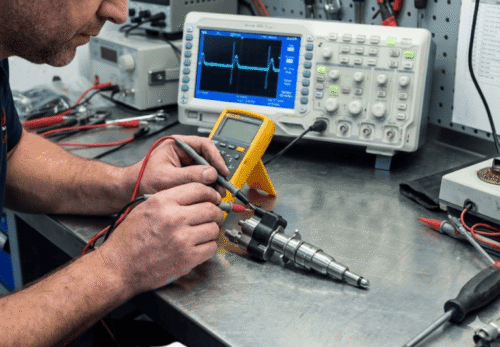
- We perform a basic electrical and pulse checks on each injector before beginning service using Multimeter. For high voltage injectors we additionally perform additional electrical insulation electrical using a Megohmmeter.
- If an injector is found to be permanently defective BEFORE we begin cleaning and testing, we will not proceed with the service. Instead, we’ll issue a refund for the injector’s service cost, there is a $0 bench fee.

Dynamic Injector Flow Testing
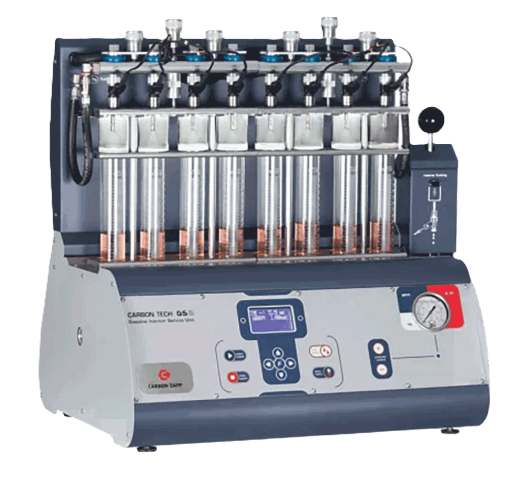
- Baseline fuel injector testing for all Port and Throttle body type injectors is performed on our Carbon Zapp GS8 port injector test bench. Each injector is flow-tested to evaluate performance, checking for leaks, blockages, spray pattern issues, and volume accuracy as well as Electrical Resistance, Short Circuit & Open Circuit Test.
- Our test bench has been upgraded to run temperature-controlled calibration fluid, maintained at 75°–80°F for consistent, repeatable results. Our standard port injector flow testing always include BOTH Static and Dynamic tests on injectors that support both. Depending on the injector type, we warm them for 2–4 minutes using 75°F calibration fluid as median temperature over time and perform testing at that temperature as well. For most injectors, the dynamic test consists of multiple full 60-second runs to ensure a proper sample.
- For GDI (Gasoline Direct Injectors) visit this specialty page covering the GDR-x test bench, along with additional injector details and disclosures.
- For Piezoelectric injectors, visit this specialty page covering the GDR-x test bench, along with additional injector details and disclosures.

Proprietary Fuel Injector Cleaning Solvents
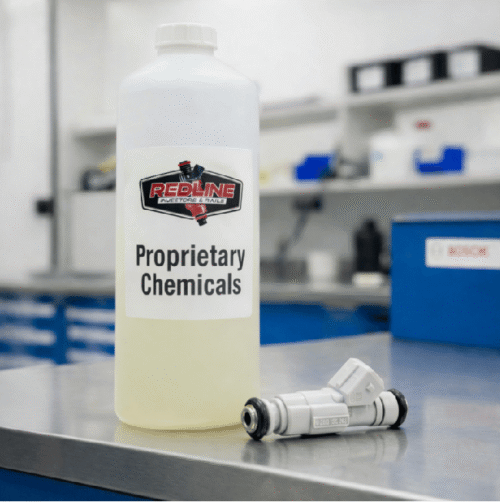
- We moved away from outdated, water-heavy injector cleaners (often 85% water) that have dominated since the late 1980s. We actually source a selection of true laboratory-grade chemicals from Lab Alley and custom-mix them in-house for injector specific cleaning applications. Our proprietary TrueFlow solvent is 100% waterless, using a blend of polar and non-polar solvents. Traditional detergents typically contain only 3–5% active solvent, with the rest made up of emulsifiers and surfactants; similar to fabric softeners; per their own SDS disclosures.
- Our TrueFlow features a high-strength formulation: 30% carbon and varnish solvents, 60% petroleum-based degreasers and carbon removers, and 10% proprietary additives. It is safe for injector coils and electronics, yet aggressive enough to dissolve carbon and varnish on contact. Its effectiveness comes from a rare balance of high surface tension, low viscosity, and slow evaporation.
- You don’t need multiple ultrasonic tanks of water based cleaning solution, what’s needed is a much better cleaning solution along with better Ultrasonic Machines.

Injector Exterior Ultrasonic Cleaning
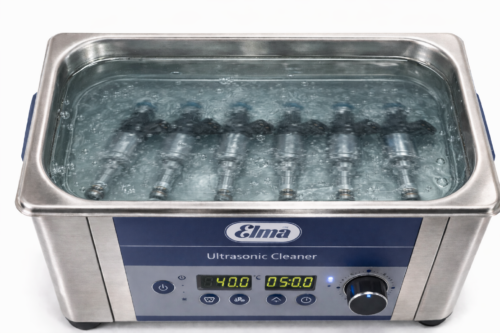
- The injectors exterior is ultrasonically cleaned in a mild 90 degree solvent for a few minutes to remove external contaminants to prevent cross contamination. A low-pressure air flush clears any remaining solution.

Injector Air Injected Cleaning

Proprietary Ultrasonic Cleaning
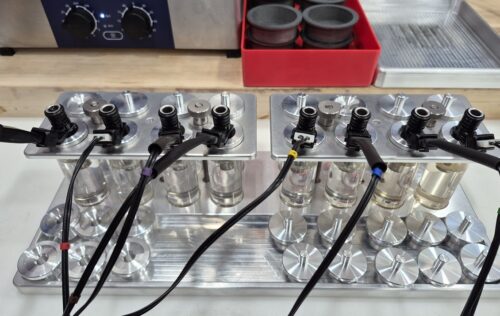
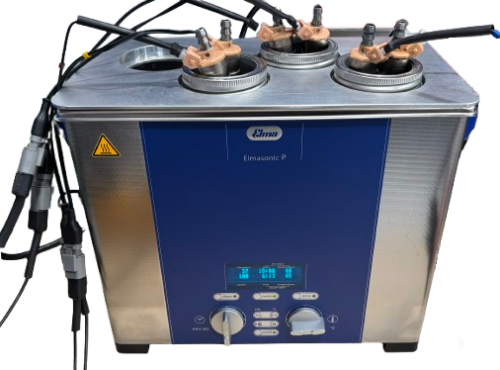
- Every injector receives this treatment at a minimum. We created an ultrasonic process using our proprietary TrueFlow waterless detergent blend of 100% polar and non-polar solvents described at the top. Here too, water based cleaners in ultrasonic proved wholly ineffective for truly stubborn injectors.
- We spent months developing this method with rigorous testing along with CAD modeling and precision CNC manufacturing of our ultrasonic plates and injector-specific adapters for our Elma ultrasonic machines. Although our fuel injector cleaning process is many times more costly and time consuming than traditional methods, the results proved to be well worth it.

Standard Injector Backflush
- Almost every top-feed, side-feed , and GDI injector receives this baseline treatment. We designed and machined custom adapter nozzles specifically for the Carbon Zapp GS8 test bench to accommodate every injector type the bench does not natively support. Heated N-Heptane is pressurized and backflushed through the injector while pulsed to remove loosened debris from previous steps. When combined with our air injected internal tip bench and ultrasonic cleaning using our TrueFlow solvent, this step often resolves performance issues. If problems persist, we proceed with our proprietary nuclear option, the POWERFLUSH procedure.
- All GDI or Piezoelectric injectors always receive the POWERFLUSH Treatment.
POWERFLUSH Fuel Injector Cleaner
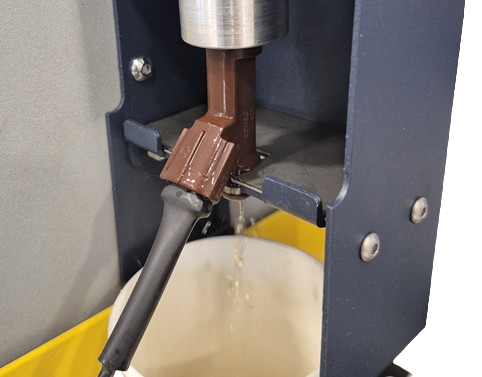
- We’ve designed countless fixtures for nearly every injector type. Watch the video to see our custom E-TEC injector 2 piece billet cups and nozzle adapters in action as an example.
- Not every injector requires every procedure. However, when problem injectors persist after standard fuel injector cleaning, we perform an additional high-pressure reverse-flow cleaning—our proprietary POWERFLUSH treatment. Injectors are removed from the test bench, and TrueFlow solvent is forced backward through them at high pressure for up to 10 minutes. This extended reverse flush removes stubborn varnish, gum, and debris through the injector’s intake, while the reverse-flow method keeps injectors cool and safely powered open for thorough cleaning.
- We utilize the same TrueFlow solvent blend and temperature controlled to 85°F for additional cleaning effect.
- Our POWERFLUSH system was CAD-designed and CNC-machined from billet 6061 aluminum by our machine shop partners. It uses a regulated high-pressure Weldon pump with multi-stage 5-micron filtration, a proprietary electronics cabinet for safe injector control, and a fixture plate with interchangeable collets and cups to accommodate various injector types.
- On occasions an injector still shows issues at this stage, it is mechanical fatigue or wear.

Port vs. Direct Bench Testing
- While a majority of shops only have a Port injector bench, GDI (Gasoline Direct Injection) injectors cannot be accurately tested on a port injector bench. Port injectors operate at 40–80 psi, while GDI injectors run at 500–3,000+ psi, far beyond the capabilities of a port bench. They must be tested for high-pressure leaks, internal sealing, and proper spray atomization and Nozzle response time none of which a port bench can measure. Testing a GDI injector on a port bench can give false “good” results or even damage the injector. While a port bench can perform basic electrical resistance checks or limited actuation confirmation, proper GDI testing requires a dedicated high-pressure test bench with OEM-style drivers, capable of accurately measuring flow, leak-down, spray pattern, and response time under real operating pressures.
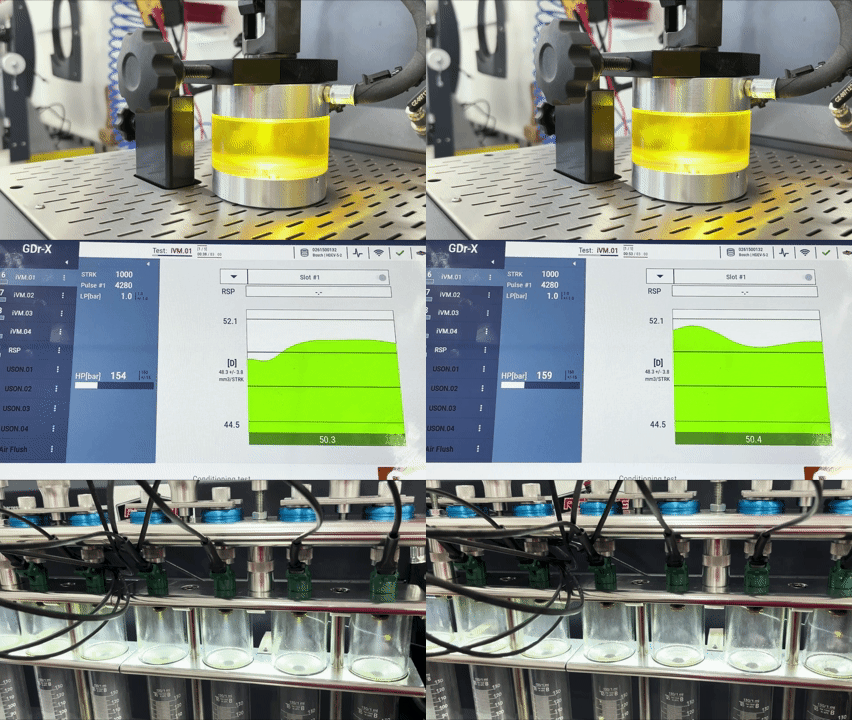
- A GM Direct injector on a port injector bench operating at up to 95 PSI, the injector can appear to gush as much as 400 cc/min, with flow measured using a graduated cylinder, whereas on a direct injector bench running at 1,500 PSI, the injector properly atomizes fuel at a much lower flow rate, with all measurements taken internally by the machine. In this example at the end, the Direct Injector bench is showing a test plan with test pressures of 160 bar (2,320 PSI).

Service Exclusions
- We do not service Diesel, CPI/SCPI Spider, FICHT injectors or Flux Capacitors.
- See our Injector Type Page for visual references
Key Topics For Fuel Injectors
What are differences between Port and GDI Injectors?
Difference Between Dynamic and Static Injector Testing
What are Signs of Clogged Fuel Injectors and How to Fix Them?
How often should I have fuel injectors cleaned and why?
How To Test Fuel Injector Coils
Shipping and Service FAQs
Service Related Questions
Yes, we have a 2 injector minimum.
Absolutely! Rest assured that we will take care of removing the injectors for you for (typically GDI and side feed) and invoice you for a bench fee of $10 per rail to do the work as problems can often arise. However, it’s important to note that we cannot be held responsible for any potential damage that may occur during the removal process. To ensure a smooth experience, we recommend that you personally remove the injectors from the rail.
To avoid any issues with shipping service secure them in plastic and tape them to prevent leaks.
For your convenience, side feed injectors will be re-installed in the fuel rails, top feed and GDI injectors will be packaged separately. GDI Injector clips are fairly easy to remove, you should not have no any issues, but if yours are tricky to remove we will can do it if you wish.
- Service prices and options are posted in store per item type as well as on the pricing page. Service Pricing
- Please check the Injector id injectors page on the menu if your unsure what you have. Injector ID
Turn around times are stated on the Home page.
We always replace filters, O-rings, seals, spacers, grommets etc. whenever they are available for the injector, this includes side feed injectors as opposed to cleaning them while still on the injector as most places do. They become fragile over time, why take a risk.
In fact we replace everything that is replicable.
Shipping Related Questions
For local drop/pick up service check the “Local Drop-Off” box on the order form.
Once order is places, email us at [email protected] for drop off instructions.
- Shipping insurance up to $100 is automatically provided.
- To add Shipping additional Insurance, please select amount coverage you’d like using the “Shipping Insurance” line item before checkout.
- Additional shipping insurance is calculated for you based on $1.60 per $100 of declared value.
- Please insure items based on their actual replacement value, extra insurance above the value will accomplish nothing, claims are on shipment value, not amount of insurance bought.
- Insurance applies only to the item we’re returning to you.
Yes we will email the contact on the “Order receipt” that we get a copy of when you place your order. Include your Name on a card or paper inside the shipment box as the shipping label sometimes gets obscured.
Include your Name on a card or paper inside the shipment box as the shipping label sometimes gets obscured.
We accept shipments from UPS, USPS, Fedex or DHL to following address 7 days a week.
Sending UPS is the optimal choice within the US, however.
Redline Injectors
3036 State Route 35 #227
Hazlet, NJ 07730
Include your Name on a card or paper inside the shipment box as the shipping label sometimes gets obscured.
When preparing the injectors for shipping, it is strongly advised to place them inside a regular zip lock bag first. This will help to keep the fuel smell contained. It is important to avoid any damage during transit, so make sure not to simply toss the bag into a box without any additional packing material. This is particularly crucial for the pintle end.
It is not recommended to ship the injectors in a bubble envelope. Optimal protection can be achieved by using a box with some padding or a bubble envelope in a box. The small flat rate box from the Post Office may be good budget-friendly option for smaller injectors.
Send the injectors with all O-rings and related components, either installed on the injectors or placed together in a bag.