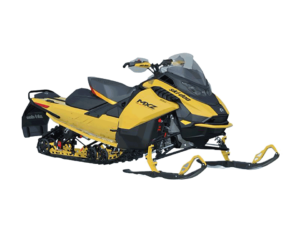
While not a comprehensive guide, it highlights several common and relatively easy-to-verify items to help troubleshoot a Ski-Doo lean condition. It is compiled from customer feedback as to things discovered over time or things they are suspicious of.
Ski-Doo engines typically do not fail due to lubrication-related issues.
-
On E-TEC engines, failures are almost always caused by a lean condition, which can result from:
-
Failing crank seals: (Perform Leak Down Test)
-
Air Leaks: (Cracks in intake boots, loose intake manifold, poorly sealed hood/airbox components allowing unmetered air in. Snow particles can bypass stock pre-filters, leading to moisture entering the airbox. Upgrading to finer mesh pre-filters is a common 2026 recommendation.
-
Ingesting snow/Blockage: Deep snow can cover the hood or air intakes
- Exhaust Leaks: Cracks or splits in the exhaust system can create backpressure issues, sometimes causing lean conditions.
-
Oil pump seal issues: A failing seal can let too much oil into the crankcase, creating a lean condition.
-
-
Check the fuel pressure regulator; it can partially pop out and allow air to enter the system.
-
The PTO side of many engines can run hot, often due to heat transfer from the clutch.
-
Fuel injectors should be sent out for cleaning and replacement of O-rings and crush rings and then monitored.
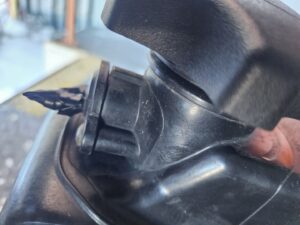
Filler Hose Check Valve
- On the 800 series (maybe 850 only, not sure), the fuel filter pipe going into the tank between the tank and the filler cap has a fitting (I think it is a checkvalve) that can dislodge slightly as only 1 screw on 1 side to hold it on. It can get cocked. It may contribute to air ingestion which if sucked into the lines while bouncing around could cause a lean condition. Not saying this is a cause… but the 850’s seem to be getting air into the system and the mag side get the fuel first along with the air and whalla. Image Courtesy of customer Brian G.

Ski-Doo Spark plug indexing
-
Improper sled operation can be caused by incorrect spark plug indexing or ground electrode positioning.
-
Ski-Doo states in their service manual that using an incorrectly indexed spark plug will result in poor idle and increased emissions.
-
When installing a spark plug:
-
The open end of the ground electrode should face the injection spray, or be within 90 degrees of it.
-
The ground electrode should not face away from the injector.
-
-
Proper indexing prevents the ground electrode from deflecting the injection spray and ensures reliable ignition, especially at idle.
-
Ensure spark plugs are properly torqued into the cylinder head.
-
Replace spark plugs every 5,000 miles or 3 years, whichever comes first.
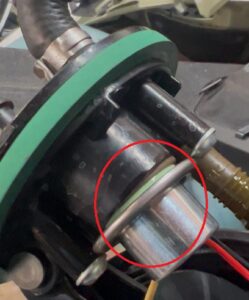
Fuel Pressure Regulator
Another thing to check is the fuel pressure regulator, it can pop out slightly allowing air in, courtesy of customer submitted photo. I lost track of the customer who sent this image, but I believe it is specific to the 600 series not the 8xx.
Dual Injection System
There is possibility of the boost injectors not performing as well on some models. The Ski-Doo models with the Rotax 850 E-TEC engine (including the naturally aspirated and Turbo R versions, maybe some others) have a dual injection system, which combines E-TEC direct injection with additional booster port injectors.
- This system uses:
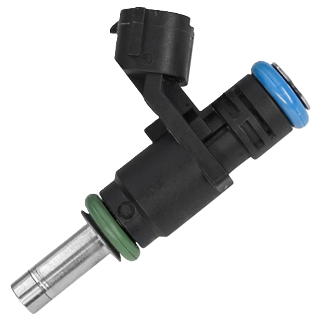
E-TEC direct injectors that inject fuel directly into the combustion chamber for efficient operation, especially at lower RPMs and loads. - Booster (port) injectors located in the intake system (specifically the boost port) that provide additional fuel when demanded, typically at higher loads and RPMs, for enhanced performance. (The specific injector is shown below)
- This combination allows the engine to optimize fuel efficiency and low emissions under normal riding conditions, while also delivering high power when needed.
Additionally see the following: