Checking Fuel Injector Resistance:
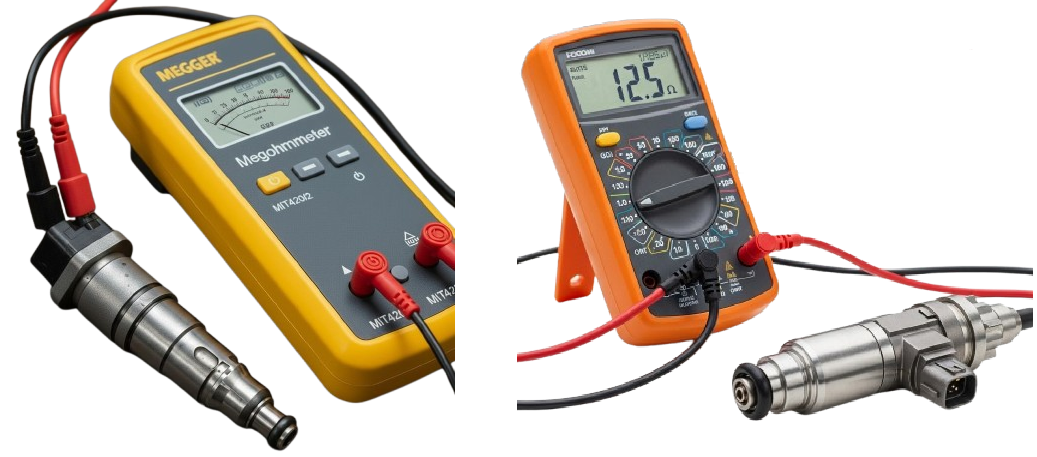
For GDI and Port fuel injectors, only a multimeter is required. For BMW Piezoelectric injectors, you’ll also need a megohmmeter.
To check the fuel injector resistance, follow these steps:
Tools Needed:
- Multimeter (preferably digital)
- Safety gloves (optional)
- Vehicle’s service manual (optional)
Multimeter Steps For Ohm Testing:
- Ensure Safety:
- Turn off the engine and remove the keys.
- Disconnect the vehicle battery to avoid any electrical shock or short circuit.
- Locate the Fuel Injectors:
- The fuel injectors are typically located on the engine, near the intake manifold.
- You might need to remove some parts or covers to access them.
- Disconnect the Fuel Injector Connector:
- Carefully disconnect the wiring connector from the fuel injector. This will give you access to the terminals where you’ll be measuring the resistance.
- Set Your Multimeter:
- Set your multimeter to the resistance (Ω) setting, use auto range feature if you have it.
- Measure Resistance:
- Place the multimeter probes across the two terminals of the fuel injector connector.
- One probe goes on the positive terminal, the other on the negative terminal (it doesn’t matter which probe goes on which terminal when measuring resistance).
- Read the Multimeter:
- A typical fuel injector will have a resistance range between 10 to 15 ohms (for most gasoline engines).
- If the reading is too low on an injector (e.g., 1-2 ohms), while the others read high, the injector may be shorted, indicating a problem.
- If the reading is too high (e.g., infinite resistance) the injector could be open, suggesting a fault.
- If the injector reads “Open” it has a broken coil circuit and the injector is bad.
- Some injectors are “low Impedance” meaning they will measure in the 1.2 ohms – 2.5 ohms range. If they are all low then you have low impedance injectors.
- Compare Results:
- Compare the resistance readings with the manufacturer’s specifications for your vehicle’s injectors. The service manual or a professional can help provide the correct range. If not known compare the results to each other.
- Reconnect Everything:
- After testing, reconnect the fuel injector wiring and reassemble any parts you had to remove.
Additional Tips:
- If you’re checking multiple injectors, compare the resistance across all of them. They should all be fairly similar.
- If you’re unsure of the resistance range, it’s always best to consult the vehicle’s service manual or contact a professional mechanic.
By following these steps, you can determine whether your fuel injectors are functioning properly based on their resistance readings.